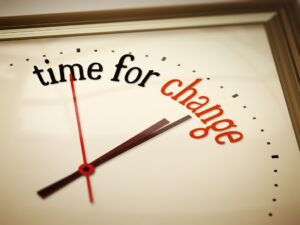
Time For Change

“If you don’t like something, change it. If you can’t change it, change your attitude.” – Maya Angelou

How well do you embrace change? Research conducted by Pritchett finds that some 20% of people are change-friendly. They are willing to embrace change and are typically those who will drive it in their organizations. Another 50% are fence-sitters. They assume a neutral position, figuring out which way to lean. The remaining 30% are the resisters. They are antagonistic toward change and deliberately try to make it fail.

Even good change has been hard to come by over time. In many ways, we are settlers. We settle for what is, would not be burdened by learning something new, and would prefer to keep antiquated systems even when new ones would be more beneficial.

Take electricity, for example. I read that when electricity was first introduced in buildings and homes, people feared it. There were no safe circuits available. When electric lights were introduced to the White House in 1891, President Harrison feared electrocution and even avoided touching them.

A newspaper entry from 1900 reads, “Do we really need it when gas lights work just fine, and horses are easier than cars?” 

As we enter 2026, we stand on the brink of many changes. Some are known, but many are not. Over the years, here is what I have learned about change.

Your attitude toward change is more important than the change

The only constant is change. We can control some changes, but can’t control most of them. However, we always have control over our attitude toward it.

When it comes to change, your attitude will help you navigate it, and how you navigate it will determine your success and peace of mind. Be careful about the choices you make.

You can be a change agent or a change spoiler.

As a leader, you are uniquely positioned to be a change agent for good. To that end, the world needs you. But you can’t be a change agent for good from the sidelines. Granted, not every idea for change is good, but not every idea for change needs to be resisted.

Your role as a leader is to be engaged, have the wisdom to discern right from wrong, and be the voice of reason.

Your personal growth is attached to your ability to change

John Maxwell said, “Change is inevitable; growth is optional.” And this is the secret sauce of your success. Change is going to happen with or without you. Your growth is optional.

Maxwell also said, “People change when they hurt enough that they have to change, learn enough that they want to change, receive enough that they can change.” 

So, in what ways do you want to change in 2026? What are you willing to do to embrace change? What will you do to grow in 2026 and become the person God desires you to be? Ready or not, 2026 is here, and it’s time for a change.


Listen For The Magic

Credit: Google Images

When something exceeds your ability to understand how it works, it sort of becomes magical. – Jonathan Ive

Not long ago, I was walking into a store and, from a distance, I heard the very familiar sound of a bell ringing. There was no mistaking this sound. It’s one that I have heard many times before. It brought a smile to my face as it does each Christmas season. 

That familiar sound of the Salvation Army bell ringer is one that I was introduced to as a teenager many years ago. My father taught my siblings and me the importance of remembering others during seasons like this, and for several consecutive years, had us working as bell ringers during the Christmas season. 

It was an important lesson he wanted to impart to us about doing something tangible to help and serve others. It was an early introduction to framing my leadership later in life.

Not only did my father have us ringing bells for the Salvation Army out in the frigid temperatures several Christmas seasons in a row, but he also led by example. He was out there with us. He did this not because we needed the money, but because others did. 

The busyness of the season produces many casualties, least among them the ability to pause and reflect on the things that truly matter. The magic of Christmas gets lost in the stress over our Amazon packages arriving on time, company parties we’d rather skip, seeing relatives who drive us crazy, and fretting over whether you’ll get that latest “trending” toy that you will have at a yard sale next year. Sound familiar?

But amid all the noise, chaos, and stress comes an invitation to listen for the magic. But where do you find it? Here are a few ways it happens:

  • The magic happens when you listen for the faint sound of the bells.
  • The magic happens when you see the wonder of Christmas through a child’s eyes.
  • The magic comes when you deliver cookies at the local nursing home.
  • The magic happens when you provide a meal for an elderly neighbor.
  • The magic comes when you volunteer at your local food pantry.
  • The magic happens when you realize that the Christmas season doesn’t have to be perfect; you only need to be present.

Many years have passed since those bell-ringing days with the Salvation Army. It draws me back to where I learned some of life’s most important lessons. Those lessons didn’t come from a book or a lecture, but from a bell and a red kettle. 

As you navigate your way through the final days and hours of the Christmas season, I trust that it will be a magical time for you. I hope you will discover or rediscover the magic it offers.


©2025 Doug Dickerson 

The Blessing of Crooked Paths

Two roads diverged in the woods, and I took the one less traveled.- Robert Frost

Architect Frank Lloyd Wright once told of an incident that may have seemed insignificant at the time, but had a profound influence on the rest of his life. The winter he was 9, he walked across a snow-covered field with his reserved, no-nonsense uncle. As the two of them reached the far end of the field, his uncle stopped him.

He pointed out his own tracks in the snow, straight and true as an arrow’s flight, and then young Frank’s tracks meandering all over the field. “Notice how your tracks wander from the fence to the cattle, to the woods, and back again,” his uncle said. “And see how my tracks aim directly to my goal. There is an important lesson in that.”

Years later, the world-famous architect liked to tell how this experience had significantly shaped his philosophy of life. “I determined right then not to miss most things in life, as my uncle had.” 

Since I can remember, I’ve always had a knack for coloring outside the margins, and whenever possible, taking the backroads. As an avid photographer, my camera bag has been a constant companion along the crooked paths to see things most never do. 

In leadership, your path to personal growth and success is rarely a straight arrow trajectory. It’s more like a squigly path of many twists and turns that leads you to where you go. 

I can look back on my leadership journey, as I am sure you can too, and reflect on all of the different twists and turns it has taken over time.

But it is in the meandering and unexpected turns that you develop your sense of purpose. Meandering doesn’t reflect wasted time; it’s merely time invested in gaining a larger perspective on the journey. Crooked paths build character.

So what should your approach be to the crooked paths and meandering spirit? Allow this fellow journeyman to share a few thoughts with you.

Crooked paths give you greater insight

A natural tendency in leadership is to seek direct paths to desired destinations, thinking that this approach is the most efficient. And in some situations, that thinking holds.

But what if in your destination for your business or you personally, was filled with crooked paths, and that maybe these paths give you a greater appreciation for the destination because of the lessons you learned along the way? The insights you gain on crooked paths today will better equip you for future paths.

Crooked paths build resilience

One of the most crucial skill sets you will develop over time as a leader is resilience. It’s the one skill that will empower you to keep going when you feel like giving up. The crooked path is the secret sauce to building resilience. 

Over the years, here’s what I’ve come to learn. My crooked paths at times were chosen and intentional. At other times, they were detours, and sometimes they were the result of me somehow losing my way. Regardless of how you come to find yourself on the crooked path, embrace it as your opportunity to learn, grow, explore, and not let it go to waste. On every crooked road is a lesson to learn. 

So let me ask, what path are you on in your leadership journey? Don’t make the mistake of thinking that because you are on a crooked road and you feel like you are meandering, that you have somehow lost your way. It very well may be the right road, at the right time, to prepare you for the next season in your life. This is not wasted time; it’s preparation. Embrace the blessing on the crooked road.

©2025 Doug Dickerson