It’s not whether you get knocked down, it’s whether you get up – Vince Lombardi
Recently, my wife and I went up to the Smoky Mountains for a long weekend. It’s something we do each October around my birthday. It’s a great time to take in the Fall colors and reconnect with nature. We both enjoy being outdoors, hiking to waterfalls, and exploring nature.
As a photographer, I also use the time to update my portfolio with new pictures. I had scouted out a place where large herds of elk gather each morning and evening to graze in a meadow. It was a perfect spot, and I was ready for the experience.
I had great success on my first outing and decided to return the next morning at sunrise to shoot from a different part of the field. Sure enough, a large gathering of elk dutifully arrived for their morning graze. I had a great angle on a large bull elk, and as I stood at a fence capturing some fantastic shots, it was all going well, until it wasn’t.
This large bull elk decided I was too close and came walking toward me. I kept taking pictures. He kept making that noise to inform me that I wasn’t welcome. His walk now became a trot, and he began to come at me with a higher degree of frustration. It was now time for me to listen and, more importantly, get moving. He was coming at me.
I did the only sensible thing I could in the moment – run! As I took off in the wet grass, it didn’t take me long to trip and face-plant on the ground. My only concern in the moment was whether or not the elk had decided I was worth the trouble of stepping over the fence and continuing the pursuit, or if he was content enough to get a good laugh at me, all sprawled out of the ground, a muddy mess. Thankfully for me, he chose the latter.
With my pride hurt, I got myself up, brushed off the grass and mud I was covered in, gathered my gear, and decided that a safer distance was now in order. After all, I did have a long lens on the camera, so I may as well use it.
The experience wasn’t lost on me from a leadership perspective, and perhaps there’s something in the story for you as well. Here are two of my takeaways.
Ignore warning signs at your own peril
Be it physical warning signs or the loud bulge of the elk, you and I ignore warning signs at our own peril.
In your leadership, you have warning signs to watch for as well. For instance, how’s your workplace culture? What signs are you ignoring that things may not be as healthy as they should be? What actions do you need to take? If we are missing the obvious cues around us, we put ourselves and others in jeopardy.
Get back up when you fall
Every leader I know has, at one time or another, fallen. It’s going to happen. It may be the result of your actions and decisions, or some other circumstance. As leaders, we must learn how to fail and fall forward. It’s what will set you apart as a leader.
John Maxwell said, “God uses people who fail- ‘cause there aren’t any other kind around.” And this is the challenge we all share as leaders. Will we use the experience of falling or failure to move us forward, or will it be the place where our dreams die? It’s our choice. And my choice—and hopefully yours—is to fail forward. Get up, and keep going.
Winston Churchill exclaimed, “Success is not final, failure is not fatal, it is the courage to continue that counts.” Embrace courage today and know that many great successes await you once you get back up.
©2025 Doug Dickerson
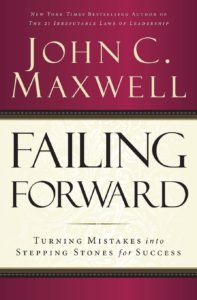 In his book,