Are You a Leader That Lifts?

Credit: Google Images

A race, like an individual, lifts itself up by lifting others up. – Booker T. Washington

Chances are you have never heard of Cooper Erickson and Ethan Olds. And you wouldn’t be alone. Cooper and Ethan gained notoriety back in September of 2023 when competing in a track meet. 

Cooper, a sophomore at Stevens Point Area High School in Wisconsin was on his way to a third-place finish in the race when he saw the runner in front of him stumble and fall. Instead of running past him to cross the finish line in second place, Cooper ran back and helped the runner, a competitor from another school.

Ethan Olds, a classmate of Cooper was coming up behind Ethan in fourth place. When he saw his teammate stopping to help, he also ran back to help.

When asked about what he did, Cooper said, “When you start to take running very seriously, you build a community, and that community is so wide– it’s just whoever you race, you have respect for because they are giving it their all. And I thought that was more important than necessarily finishing in second place or third place.”  (Read the story here)

What the two high school students did at that event serves as a great lesson in leadership. While the boys were only in high school, some might have given them a pass if they had not stopped to help their fellow competitors – they are high school students after all. 


The example of Ethan and Cooper is one worth emulating. As John Maxwell said, “Leaders who fail to lift others in the long run, fail to lift themselves.” And this goes to the heart of your leadership. Why is lifting others essential to your leadership? Let’s explore these three ways.

Leaders who lift have set aside their insecurities

This is perhaps one of the most common causes as to why some leaders don’t lift others. So long as you are insecure you will always be looking upon others with a suspicious eye. This posture puts a lid on your leadership, and what’s worse is that by doing so, you hold others back and keep them from reaching their potential.

Leadership Tip: Don’t allow your insecurities and pettiness to hold others back. The people around you need your best, not your baggage.

Leaders who lift give hope

Something special happens when a leader lifts another person. A shift happens that creates a new level of momentum and energy. Perhaps that person has been stuck, feeling despondent, and believes that the struggle is not worth it. Your one selfless act of leadership can be all it takes to turn things around and give hope to that aspiring leader.

Leadership Tip: Daily look for opportunities to be a leader that lifts. Who needs your hand today?

Leaders who lift build the future

When you lift others, you are helping build the next generation of leaders. In the end, it’s not about what you did for yourself, but what did you for someone else. Did you lift, build, encourage, and inspire those around you? A simple act of kindness on your part by lifting someone else is laying the foundation for another’s rise in leadership.

Leadership Tip: Being a leader that lifts is a recognition that we are all in this together. Lift others, be humble, and remember that it’s OK to turn around in your race and pick someone up.


©2024 Doug Dickerson

It’s A Matter of Focus

Credit: Google Images

Where focus goes, energy flows. – Tony Robbins

On more than one occasion over the years, I’ve come away disappointed with what would have been a great photograph that I ruined by one major mistake. It was out of focus. Ugh!

You would think that after a lifetime of taking pictures and being an avid photographer, I would know better. It’s not like the concept is new to me. After all, I’ve won awards for my photographs and have taught classes for others to better improve their photography skills.

But focusing issues is a common mistake in photography whether you’re an amateur or professional if you’re not careful. The primary reasons are that the camera moved, the subject moved and you didn’t adjust in time, and missed focus among other things. 

In leadership, we often hear that we need to see the big picture – and we do. It’s important to understand where you are, know where you are going, and set proper goals to get there. 

The broader the picture, however, the harder it is to narrow your focus on the things in your leadership that matter most. In photography, you might appreciate the big picture from an artistic point of view, but finer details and focal points can go unnoticed and underappreciated.

In your leadership, what you focus on matters. As Tony Robbins said, It’s where your energy flows. How can you get your leadership in focus and activate your energy? Here are a few tips.

Focus on daily growth

Focusing on the daily disciplines each day that advance you toward your goals. It’s normal to want to rush the process and overnight be at a level of success that took others years to attain. But that’s not how they achieved it and chances are, neither will you. Don’t despise the importance of daily growth.

Focus on serving others

An essential characteristic of your leadership is found in serving others. Someone once said, “If serving is beneath you then leading is beyond you,” and this is one of the most essential characteristics of leadership to learn. Understanding that it’s not about you will remove the focus from yourself and where it belongs – serving the needs of others.

Focus on adding value to others

Similar in nature to serving others, adding value is a key component of your leadership. Zig Ziglar said, “You can have everything in life you want if you will just help other people get what they want.” Adding value to others allows you to put into practice the discipline of serving others tangibly. By doing so, you are showing yourself to be a selfless leader that’s worthy of following.

Focus on your priorities

As a leader, you have to know the difference between what’s important and what’s important to you. Many leaders lose their focus when it comes to priorities because they get sucked into the “tyranny of the urgent” that others create. Learning how to stay in your lane and focus on your priorities is a matter of good self-leadership. There’s a difference between adding value to others and adding to the drama. Understand the difference and stick to your priorities. Click To Tweet

Focus on consistency

John Maxwell said, “Small disciplines repeated with consistency every day lead to great achievements gained slowly over time.” And this is the secret sauce of focus. When you focus on being consistent with your growth and daily disciplines, you will rise in your leadership.


Final Thought

Famed photographer Ansel Adams said, “A good photograph is knowing where to stand,” and it’s true in your leadership. Where you stand matters. And once you know where you stand, everything comes into focus.


©2024 Doug Dickerson


Not More Life As Usual

Credit: Google Images

Your present circumstances don’t determine where you can go; they merely determine where you start. – Nido Qubein

Some years back, I read an account of the U.S. standard railroad gauge (distance between rails) and how it came to be set at 4 ft., 8 and one-half inches. 

Why was it set at such an odd number? The reason? Because that’s the way they built them in England, and American railroads were built by British expatriates. 

But why did the English adopt that particular gauge? Because the people who built the pre-railroad tramways used that gauge.

They, in turn, were locked into that gauge because the people who built tramways used the same standards and tools they had used for building wagons, which were set on a gauge of 4 feet, 8 and one-half inches.

Why were the wagons built to that scale? Because with any other size, the wheels did not match the old wheel ruts on the road. 

So who built the old rutted roads? Imperial Rome built the first long-distance highways in Europe for the benefit of its legions. The streets have been in use ever since. Roman war chariots first made the ruts. Four feet, eight-and-one-half inches was the width a chariot needed to be to accommodate the rear ends of two war horses.

The account of the railroad system is emblematic of the way many people go about accepting and living their lives.

Many people find themselves living their lives according to the “standard gauge” that others have imposed on them. Breaking free from this entrapment of low expectations is nothing more than a pipe dream filled with “one of these days” thinking that slowly turns into faded memories of what could have been.

As you read this, reflect briefly on why you do what you do. Think of the patterns and routines in your life. Are you in the driver’s seat as it pertains to your goals, dreams, and aspirations? What gets you up early in the morning and keeps you up late at night? What are you pursuing in life that you are passionate about? And, are you moving in the direction of those passions?

I know that “standard gauge” thinking – accepting things because “it’s always been this way”-  is the greatest obstacle standing in the way of where your heart, passion, and talents could otherwise take you. It’s what kills your dreams and causes you to:

  • Embrace the status quo
  • Believe that success is out of your reach
  • Believe that you are trapped where you are
  • Believe that others are more deserving of success than you

Zig Ziglar said, “If you don’t see yourself as a winner, then you cannot perform as a winner.” And this is my challenge for you:

  • Don’t allow the “standard gauge” of others to define who God has created you to be and to become. 
  • Don’t allow your negative self-talk to defeat you
  • Don’t be afraid to take risks, fail, and try again!

My prayer for you in 2024 is that you will:

  •  Deepen your perspective of who you are and why you were created (your spiritual life, which grounds you)
  • Align yourself with like-minded people who share your values (this is your tribe whom you share life)

Welcome to 2024! May it be your best yet!

©2024 Doug Dickerson

Don’t Give Up On Your Dreams

Credit: Google Images

The price of anything is the amount of life you exchange for it. – Henry David Thoreau

It’s the most wonderful time of the year, so says the song. Speaking of Christmas songs, which one is your favorite? 

Not long ago, I came across an article in Readers Digest that gave the backstories of some of the most popular Christmas songs. As a fan of backstories, it caught my attention. I’d like to share one of them with you.

The year was 1944, and songwriter Hugh Martin was fooling around with a little medley, but it wasn’t working. “So he played with it for two or three days and then threw it in the wastebasket,” his songwriting partner Blaine told NPR in 1989. Blaine made him get it out of the trash. And it’s a good thing, the song ended up being “Have Yourself a Merry Little Christmas.” 

Martin was writing the song for the film Meet Me In St. Louis. Supposedly, the song was a bit too melancholy for Judy Garland’s character in the movie, so Martin and Blaine rewrote the lyrics to be cheerier. “The film producers said, ‘It’s a sad scene, but we want a sort of upbeat song, which will make it even sadder if she’s smiling through her tears,” Martin said. “Then we wrote the one you know in the movie.” The song was a hit and has since been remade by many artists.

When reading a backstory like that one, I can’t help but wonder how many other Hugh Martins are out there – those who have – for whatever reason, have tossed their dream in the proverbial wastebasket. How many have chosen to give up in the face of opposition? How many have succumbed to discouragement to the point of giving up? 

It was Thomas Edison who said, “Many of life’s failures are people who did not realize how close they were to success when they gave up.” Truer words have never been spoken.


But did you also know that Edison faced tragedy of epic proportions when his lab was destroyed by fire? In the aftermath of that fire, Edison said, “Thank goodness all of our mistakes are burned up. Now we can start fresh again.” And this is the posture of a man who would not be held back.

As you spend time reflecting during this Christmas season and as the year comes to a close, I want to challenge you to think about your blessings rather than your troubles. Try meditating on the good that’s come your way and the good you can do.It’s all too easy to see the bad taking place in the world, but what you dwell on is a choice and that choice shapes your point of view. Click To Tweet

Let me close by reminding you of the lyrics of “Have Yourself a Merry Little Christmas”:


Have yourself a merry little Christmas

Let your heart be light

Next year all our troubles will be out of sight

Have yourself a merry little Christmas

Make the Yuletide gay

Next year all our troubles will be miles away

Once again, as in olden days

Happy golden days of yore

Faithful friends who are dear to us

Will be near to us once more

Someday soon we all will be together

If the fates allow

Until then, we’ll have to muddle through somehow

So have yourself a merry little Christmas now

I encourage you to discover the hope of the season, and the dreams in your heart, and to know that nothing is out of your reach so long as you have faith. 

Merry Christmas and Happy Holidays!


©2023 Doug Dickerson

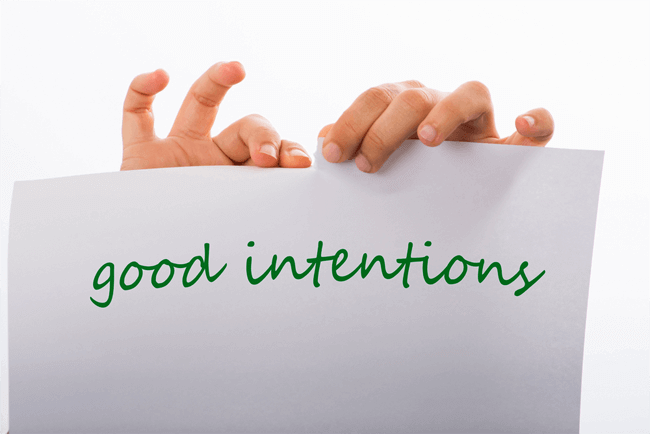
The Problem With Good Intentions

Credit: Google Images

Everything worthwhile is uphill. – John Maxwell

After 36 years of marriage, I’ve learned a thing or two about good intentions. Most of them the hard way.

I recall the time when I was using the mixer to make some cookies. This was early on in our marriage. Up to that point, I had used it numerous times without incident. On this particular occasion, however, things went sideways and I managed to burn it up.

When Christmas came around a few months later and feeling remorse for what I had done with the decommissioned mixer, I made the decision to purchase a new one for her. Now, keep in mind, that this was just one of the many presents that I gave her. Surely, my wife would appreciate a new one, I reasoned.

I was wrong.

Her appreciation for receiving a new mixer did not match my good intentions of giving it to her. Needless to say, in the years since that incident, never has appliances been associated with Christmas. 

Good intentions – while good, are never enough. Hang around in leadership long enough and you will learn this. Here’s what I know about good intentions:

  • Good intentions reflect a dream or desire for something better
  • Good intentions reflect that you have ambition
  • Good intentions reflect that you care and are invested on some level

But my good intentions and yours are never enough.

John Maxwell said, “One of the greatest gaps in life is between sounding good and doing good. We are ultimately measured by what we do and how our actions shape the world around us. Without results, all the best intentions in the world are just a way of deluding ourselves.” And this is a gap in your leadership that needs to be bridged.

The key to moving from good intentions to action and results is found in self-discipline. It’s not what you start, plot, or plan, but what you get done.

Think for a moment about what your life – both personally and professionally, would look like if you moved from good intentions to actions and results. Consider the following:

  • What would your relationships look like?
  • What would your finances look like?
  • What would your career look like?
  • What would your faith look like?
  • What impact can you envision making on the world?
  • What would you attempt to accomplish if you had the discipline to move from good intentions to action?
While it’s true that everything worthwhile is uphill, that should not stop you. It should challenge and inspire you. Click To Tweet

The late Zig Ziglar said, “You don’t have to be great to start, but you have to start to be great.” And this is your leadership challenge- to start!

So let me ask you, what’s holding you back from taking action? Is it a fear of failure? Is it a fear of what others might say or think? Is it a lack of confidence in your own ability? Whatever it may be, let me be the first to encourage you to set those fears aside and simply start. 

Final Thoughts

My wife and I are able to now look back and laugh about her getting the mixer for Christmas. But it was a lesson learned that helped me realize that despite my good intentions at the time, I could have at least waited until Valentine’s Day to give it to her.


©2023 Doug Dickerson

High Stakes Growth

Credit: Google Images

Those at the top of the mountain didn’t fall there. – Marcus Washling

I read a story about an animal trainer for Hollywood movies who was once asked how he could stake down a full-grown elephant with the same size stake used for a baby elephant. “It’s easy,” replied the trainer, “When they are babies, we stake them down. They try to tug away from the stake maybe ten thousand times before realizing they can’t escape. At that point, their ‘elephant memory’ takes over, and they remember that they can’t get away from the stake for the rest of their lives.”

Regarding your personal growth and development as a leader, you must be fully aware of your surroundings and the stakes that would hold you back and prevent your growth. Nido Qubein put it this way, “ Whether you are a success or a failure in life has little to do with your circumstances; it has much to do with your choices.” Your choices will make or break you as a leader. 

When it comes to your personal growth and development, you must make wise choices about the stakes that could hold you back. What are they? Let’s explore a few together.

The stake of what other people think

How far you can go, how high you can climb, and what you can achieve are not determined by the limitations others may try to place on you. Don’t let the negative things others say become a stake that prevents you from achieving your goals. It’s not what others say but what you believe that matters.

The stake of failure

John Maxwell said, “The difference between average people and achieving people is their perception of and response to failure.” How you respond to failure will either be a stake in the ground that holds you back or a stepping stone to a brighter future because you dared to believe that your failure wasn’t fatal or final but an opportunity for growth.

The stake of your comfort zone

Comfort zones tend to lull you into playing it safe. This is perhaps the most dangerous stake because of the false sense of security it gives you. It causes you to embrace your worst fears rather than your greatest strengths. It turns you into a spectator of others’ achievements while making you settle for less than you can achieve.

The stakes of comparing yourself to others

One of the most damaging things you can do on your personal growth journey is compare yourself to others. It’s a distraction at best. You can look at what someone else is doing and achieving and talk yourself into believing you can never succeed on their level. You can compare yourself to another and think you are so much better. Either way, it’s unhealthy. Run your race with all your strength, stay in your lane, and don’t worry about the person beside you.  

The stake of no discipline

Bruce Springsteen said, “A time comes when you need to stop waiting for the man you want to become and start being the man you want to be.” If you desire to grow and develop as a leader, then it’s up to you to uproot the stake of an undisciplined life and take intentional steps that will move you from where you are to where you want to be. Wishful thinking will not suffice. 

Final Thoughts

You will never achieve all you can unless and until you believe that the stakes holding you back are not worth comparing to the rewards that await you when you think you can achieve anything you set your mind to.


©2023 Doug Dickerson

Check These Boxes For Effective Change

Credit: Google Images

Whether you are a success or failure in life has little to do with your circumstances; it has much more to do with your choices. – Nido Qubein

How adaptive to change are you? Are you an early adapter or a reluctant embracer of change? What is your initial response to the word change? What emotion does it invoke when you hear the word? Do you naturally resist change?

In his book, The 15 Invaluable Laws of Growth, John Maxwell shares the following story about a lonely woman who purchased a parrot from a pet store:

After only one day of having it, she returned to the store and told the storekeeper how disappointed she was with it. “That parrot hasn’t said a word yet!” she lamented.

“Does it have a mirror?” asked the storekeeper. “Parrots like to be able to look at themselves in the mirror.” So the lady bought a mirror and returned home.

The next day she was back again, reporting that the bird still wasn’t speaking. “What about a ladder?” the storekeeper asked. “Parrots enjoy walking up and down a ladder.” So the parrot owner bought a ladder and returned home.

On the third day, she was back again with the same complaint. “Does the parrot have a swing?” was the shopkeeper’s solution. “Birds enjoy relaxing on a swing.” She bought the swing and went home.

The next day she returned to the store and announced that the bird had died. “I’m terribly sorry to hear that,” said the storekeeper. “Did the bird ever say anything before it died?”

“Yes,” said the lady. “It said, ‘Don’t they sell any food down there?’”

What’s the moral of this silly story? Change for the sake of change isn’t going to help you. If you are going to make changes, you must make sure they’re the right ones.

This humorous story illustrates that while we can be busy making changes in hopes of a different outcome, change for the sake of change does not guarantee it. 

Wiring in Management Journey, Robert Tanner states, “The truth is that human beings do not naturally resist change. We accept changes to our lives all the time, especially when we like the change that others present to us. We will change if we believe the change will be beneficial to us.” And this is a challenge for many leaders. How well do you communicate the benefits of change in a way that people will step out of their comfort zones and embrace it?

We resist change for the obvious reasons:

  • Fear of the unknown
  • Loss of control
  • Lack of clarity or understanding of why the change is beneficial

Or it could simply come down to what my good friend Jeff Turner says, “I’m pretty stubborn”, which is reflective of how many of us feel about change at times. We just don’t want to go there. 

If you are a leader about to implement change in any capacity, make sure you have checked these boxes before proceeding.

This change is the right change and comes at the right time

Nothing could be worse than making the right change at the wrong time. Make sure that the change is right and your timing is right. If not, you are about to navigate some rough times.

This change reflects a consensus of your key people

Making change without the input and counsel of your key people can cause great damage. The people most impacted by a major change should be seated at the table during discussions prior to the change being implemented.

This change aligns with your values

When implementing any change within your organization, make sure that it does not in any way conflict with your core values. Any change being considered or implemented should be a compliment to your values, not an obstruction to them.

This change is worth defending

When all is said and done, any change worth implementing in your organization must be one worth defending with integrity. If you can’t defend it, don’t implement it.

This change will stretch us

As is the case oftentimes, change will stretch you as a leader and it will stretch your team. Growth tends to do that. It will move you out of your comfort zone, cause you to look at your challenges in a different light, and grow you beyond what you previously thought possible.

Final Thoughts

Not all change is good. Not all is bad. How it works for you is the result of the choices you make along the way.


©2023 Doug Dickerson

How Pain Shapes You As a Leader

Credit: Google Images

Success in life comes not from holding a good hand, but in playing a poor hand well. – Warren G. Lester

When it comes to the painful experiences of life, I’ve never seen anyone volunteering or signing up to go through a painful experience. Have you?

But all of us have either been touched by a painful life experience or know someone who has. Life brings the sting of pain, such as (and many more):

  • The pain of a divorce
  • The pain of the death of a friend or loved one
  • The pain of a lost job
  • The pain of financial hardships
  • The pain of poor health
  • The pain change
  • The pain of caring for aging parents
  • The pain of depression

Life is full of painful experiences. And sooner or later, we all deal with those painful events. As a leader, you are not exempt.

I will never forget the painful event of losing my mother at the height of the COVID pandemic (but not due to COVID). It was one of the most painful life experiences that I had to deal with. She lived out of state and traveling back and forth was a challenge as well as being around her.

Doug with his mom.

To make matters worse, when she did pass away, we were unable to have a funeral for her as it was at the height of the pandemic and social distancing protocols simply prevented it. Not being able to have her many friends and family gather to celebrate her life was painful and disappointing.

Virginia Satir said, “Life is not the way it’s supposed to be. It’s the way it is. The way you cope with it is what makes the difference.” And this is especially true in the way you deal with painful life experiences as well as in your leadership. 

I’m a firm believer that life experiences – especially the bad ones, are teachers or guides that help us become better. How can we make sure that the experiences of life make us better and not bitter? Here are a few tips from a fellow friend on the journey with you.

Acknowledge your pain

As a leader, you are not exempt from painful life experiences. We are all touched by them. By acknowledging your pain you are simply stating the obvious that you are human like everyone else and you are not exempt from the pains and sorrows of life. 

Leadership Lesson: Pain shapes you to be a vulnerable leader.

Embrace your pain

The painful experiences of life are not meant to be bottled up. Life’s pains and traumas don’t go away by themselves. They won’t go away by ignoring them. On your leadership journey, you will deal with your own personal points of pain as well as share in the painful life events of those around you. The sooner you acknowledge and address your pain the sooner you will move to a place of healing.

Leadership Lesson: Pain shapes you to be a compassionate leader.

Adjust to your pain

What I am not advocating here is a surrender to the inevitability of continuous painful life experiences. Realistically, they are seasons we go through. I am, however, advocating for you to choose how you will face those experiences and the attitude by which you deal with them. 

We don’t always choose the experiences that we face in life, but we do choose our attitudes toward them. And to be sure, sometimes it’s not the size of the problem or the depth of the pain, but its duration that wears us down. Making the right adjustments – especially with regard to your attitude will allow you to navigate them with a clear mind and heart.

Leadership Lesson: Pain shapes you to be a resilient leader.

Emerge from your pain

Painful life experiences, while difficult and challenging at the time, in due time do pass. And to be sure, the pain is real, the scars hurt, and memories of what was will linger with us. But you can emerge from that season stronger and healthier in the end.

Max Lucado said, “A season of suffering is a small assignment when compared to the reward. Rather than begrudge your problem, explore it. Ponder it. And most of all, use it. Use it to the glory of God.” And this is the goal when emerging from life’s painful events.

Leadership Lesson: Pain shapes you to be a victorious leader.

Final Thoughts

I don’t know the season you face in your leadership right now. But I do believe that the pain you are walking through right now is going to serve a greater purpose in the end when you use it for the glory of God.


 ©2023 Doug Dickerson

Please be sure to visit and subscribe to my YouTube Channel for more leadership content. Click here to visit my YouTube page.

Resources: Books I’d like to recommend to you as a supplement to this new column.

All of these books can be ordered from Amazon.

  1. Forgiving What You Can’t Forget: Discover How to Move on, Make Peace with Painful Memories, and Create a Life That’s Beautiful Again  By Lysa TerKeust


2. Out of the Cave: Stepping Into the Light When Depression Darkens What You See by Chris Hodges

3. Winning the War in Your Mind: Change Your Thinking, Change Your Life by Craig Groeschel


4. Anxious For Nothing: Finding Calm in Chaos by Max Lucado

Do You Have a Winning Attitude?

Credit: Google Images

Your attitude, not your aptitude, determines your altitude. – Zig Ziglar

I read a story once by Michael Hodgin about two Kentucky racing stable owners who had developed a rivalry.

Each spring they both entered a horse in a local steeplechase. One of them thought that having a professional rider might give his horse an edge in the race, so he hired a hotshot jockey.

Well, the day of the race finally came, and as usual, their horses were leading the race right down to the last fence. But the final fence was too much for both of the horses. Both of them fell, and both riders were thrown. But that didn’t stop the professional jockey. He remounted and easily won the race.

When he got back to the stable, he found the horse owner fuming with rage. The jockey really didn’t understand the owner’s behavior, because he won the race. So the jockey asked, “What’s the matter with you? I won the race, didn’t I?” 

The red-faced owner nodded, “Oh yes, you won the race. But you won it on the wrong horse!”

The determination of the jockey is admirable despite the fact that he made that critical mistake. 

In leadership, you will be challenged regularly with your attitude. It comes with the territory. Sometimes the attitude challenges that we face are the result of our own poor choices. At other times, our attitude is challenged by outside forces that we have no control over.

Credit: Google Images

In the book, Winning The War in Your Mind, Craig Groescel writes:

“Our lives are always moving in the direction of our strongest thoughts. What we think shapes who we are.”

And this is precisely why our attitudes matter. Our thoughts and attitudes are moving us in a certain direction. The question is: Are you headed in the right direction?

Poor attitude choices can be a detriment to your leadership. Your attitude is basically the thermostat by which your team members adjust. Click To TweetWhen you are upbeat and positive, that tends to be the attitude that others embrace. The same holds true if it’s negative. So, as a leader, what posture should you take with your attitude? Here are a few simple approaches worth consideration.

Guard your thoughts

This first piece of advice is all about your discipline as a leader. It’s a profoundly simple piece of advice. And it’s a profoundly difficult discipline to master.  But much is riding on the outcome.

I would like for you to think of guarding your thoughts not from a defensive posture, which we’ve all been accustomed to, but from a proactive posture.

When it comes to guarding our thoughts, what does a proactive posture look like? Here are a few examples:

  • Practice gratitude and random acts of kindness
  • Prayer or meditation
  • Volunteer/ serve others
  • Exercise/walks 

When your thoughts and actions are others-centered and when you are intentional about what you choose to watch and listen to, then you are in a proactive way guarding your thoughts. You have less time to be self-absorbed and more time to focus on others.

Guard your company

We don’t always control what happens to us, but we do control how we will respond. This is crucial to understand. 

When you are proactive about guarding your mind in the ways that I have already outlined, the next thing you need to do is guard your company. Here’s a truth you must embrace: Not everyone belongs in your circle. 

As a leader, you will have many interactions with people within your organization and without. These are generally tied to your specific duties as a leader. 

But when it comes to your inner circle- the people closest to you by choice- you must guard your company. To be clear, I am not advocating being a snob. I am, however, saying that in order to protect and guard your attitude, you can’t allow others with poor attitudes in your inner circle who could potentially drag you down. Your winning attitude is too valuable and must be protected.

Final Thoughts

Possessing a winning attitude takes work, discipline, and determination. It is incumbent upon you to be proactive and wise in your choices. A winning attitude is attainable but you must guard your thoughts and guard your company in order to maintain it.


©2023 Doug Dickerson


The Amazing Power of a Thank You

Credit: Google Images

No matter what happens in life, be good to people. Being good to people is a wonderful legacy to leave behind. – Taylor Swift

As the father of two now grown and married daughters, I am a Swiftie dad. All through their teenage years our home was filled with the vibes of Taylor Swift.

It was only fitting that they traveled from South Carolina down to Tampa to see her on her Eras Concert tour. I was glad that they finally got to see her in person. It was the ultimate bucket list concert for them.

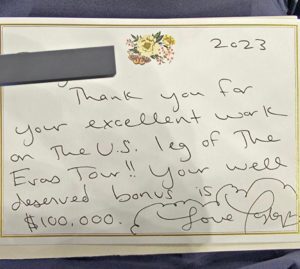
Her remarkable success speaks for itself. But what truly sets her apart is her tremendous generosity. It was reported in Forbes that she gave out bonuses totaling more than $55 million to her dancers, riggers, sound technicians, catering, and truck drivers. Multiple sources reported that she gave $100,000 bonuses to each of the 50 truck drivers on her tour.

But as impressive (and deserving) as the bonuses were, what I find most impressive is that Swift has held steadfast to the lost and dying art of handwritten notes. In fact, Swift is a prolific note-writer. 

A copy of one of the hand-written notes to a truck driver was made public in which she expressed her thanks for their hard work.

Credit: Google Images

Swift has been widely known to send these hand-written notes to friends and fans alike. This makes me wonder, could there be one for this Swiftie dad and his daughters?

In life as in your leadership, expressions of gratitude and thanks are very important. 

In fact, survey results published at BlueBoard reported that 2 in 3 (67%) of employed Americans don’t always feel appreciated for their contributions at work. In addition, nearly half (42%) of respondents feel their company lacks a strong culture of appreciation.

In light of this, what does this mean for you as a leader and for your organization to build a culture of appreciation and gratitude? Here are a few thoughts to consider.

Gratitude and appreciation are the foundation of your employee engagement

Much has been said and written here and elsewhere about employee engagement over the years. But little has been said about gratitude and appreciation being the foundation upon which it’s all built and sustained. It’s time we acknowledge it.

Building a culture of appreciation and gratitude begins with those in leadership. Some might be dismissive of this idea as simply being too much of a “soft skill” idea when in reality, it’s needed more now than ever. People will have buy-in with what they help create and when they are appreciated for their efforts and sacrifices.

Gratitude and appreciation are the future of your leadership

The future of your leadership and that of your organization hinges on your understanding of what it means to create and sustain a culture of appreciation.

In the BlueBoard survey, they also reported that a lack of employee appreciation can:

  • Cause employee disengagement
  • Impact your employees’ sense of belonging
  • Erode employee confidence
  • Trigger job insecurity and anxiety in your workplace

If you want a strong culture of appreciation, strong morale, etc., then you begin with an understanding of the power of ‘thank you’. At every opportunity, make it a practice to show your appreciation and gratitude to those around you. It means more to them than you can imagine. Click To Tweet

As for helping this dad with two daughters, I’d like to express my sincere appreciation to Taylor Swift for making our home a happier place during those middle and high school years. From the boyfriends and the proverbial broken hearts and proms, and eventually on to their weddings, Taylor’s music has been there. Now they are raising up little Swifties of their own. 

Thank you, Taylor, for accompanying us on the journey!


©2023 Doug Dickerson